Showing posts with label photography. Show all posts

Friday, April 5, 2013

San Francisco-Oakland Bridge: LEDs, Cool Photo


(Teton Gravity Research, via Wired, used w/o permission)

"Check Out the San Francisco Bay Lights in 4K Glory"
Christina Bonnington, Gadget Lab, Wired (April 1, 2013)

"The Golden Gate Bridge has long overshadowed its grayer, plainer companion, the San Francisco-Oakland Bay Bridge. That's changed, just a bit, now that the Bay Lights illuminate 'the other bridge' with the glow of 25,000 glittering LEDs.

"We've been lucky enough to see them each night since they first lit up March 5, and now you can enjoy them too - in stunning 4K definition.

"The video was shot with a RED Epic attached to Gyro-Stabilized Systems' C520, a portable five-axis gyro-stabilized camera platform. It's the first such system that is fully upgradable, interchangeable, and can accommodate 4K camera tech...."

It's a pretty cool photo. The copy in this post was cropped to fit the Lemming's format.

What's really impressive is what it took to get the video: for that you'll have to read the Wired article.

Normally, the Lemming would ramble on about LEDs, San Francisco, or maybe bridges. It's been one of those weeks, though, and the Lemming's taking a break.

Allegedly-related posts:

Monday, April 25, 2011

Television's Ephemeral Art: 'Click,' and It's Gone

"Television 'Deaths' Become Morbid Obsession for Berlin Artist"
Alice Vincent, Underwire, Wired (April 23, 2011)


"These images may look like the product of hours spent on Photoshop, but they’re actually memento mori of the kind of TV sets your parents (or even grandparents) grew up with.

"Retro televisions sparked an interest for Berlin graphic designer Stephan Tillmans after he noticed the brightly colored picture breakdown when certain screens were switched off. After much experimentation with old televisions, Tillmans realized that every old television has its own 'death,' and, with enough patience, this could become an intriguing photographic subject.

"What started as a happy discovery has turned into a kind of expertise for Tillmans, who explains to Wired.co.uk that 'some televisions give better results that others. The TVs I photograph are of different models and sizes.'

"Choosing which televisions will provide the right results is somewhat of a fine art, as television deaths that appear photogenic initially may not through a camera lens...."

There's quite a bit of work involved in getting a photo like the two in the wired.co.uk post. For starters, Tillmans hauls an old-tech television up to his fourth-floor apartment. If that's British usage, the Lemming thinks that's fifth-floor for Americans.

And the Lemming remembers the 'tube' television sets. Those things were heavy. Then, once in place, it can take Tillman 800 tries to get one photograph that's 'art' quality.

The article includes a link to more of Tillman's images, in Wired UK's gallery.

The Lemming remembers the flash-and-fade of old television sets - and other variations on that particular tube technology. It's nice to have some of those moments caught, enhanced, and preserved: But the Lemming's also glad that television technology has progressed since 'the good old days.'

Related posts:

Thursday, November 25, 2010

Van Gogh, Art, and Greenish Phytoplankton

"Van Gogh from Space"
USGS/NASA/Landsat 7, via flickr (July 13th, 2005)

"...In the style of Van Gogh's painting 'Starry Night,' massive congregations of greenish phytoplankton swirl in the dark water around Gotland, a Swedish island in the Baltic Sea. Phytoplankton are microscopic marine plants that form the first link in nearly all ocean food chains. Population explosions, or blooms, of phytoplankton, like the one shown here, occur when deep currents bring nutrients up to sunlit surface waters, fueling the growth and reproduction of these tiny plants.

"Credit: USGS/NASA/Landsat 7

"To learn more about the Landsat satellite go to: landsat.gsfc.nasa.gov/..."


As NASA put it, "This planet is so beautiful sometimes. Look at this satellite image. Something to be thankful for, yes?"

After that, there's not much for the Lemming to say.
A tip of the hat to NASA, on Twitter, for the heads-up on this photo.

Monday, November 22, 2010

Femtosecond Transient Imaging, Seeing Around Corners: Available in About Two Years

"MIT Researchers Create Camera That Sees Around Corners"
Tracie McDaniel, Science, DailyTech (November 21, 2010)

"Using ultra-fast imaging and 'echoes of light,' researchers have developed an innovative camera that takes pictures outside of traditional line of sight.

"Short bursts of light that reflect off of different objects is key for researchers at MIT. They've named the process 'Femto-Photography.' It exploits the finite speed of light and it is part of what they call the 'femtosecond transient imaging system.'

"Applying a femtosecond laser, short pulses of light bounce around off of one object and on to another before reflecting back onto the original object where it is then captured by the camera. The bursts of light last for one quadrillionth of a second. Algorithms then reconstruct what is hidden.

"According to MIT Professor Ramesh Raskar, the camera creates a '3D time-image' of the unseen image, by continuously gathering light and computing the time and distance that each pixel has traveled...."

Two words:
  • Oh
  • Wow
This technology is in its very early stages - sort of like X-ray machines, about a hundred years back. (November 8, 2010) The DailyTech article doesn't show any pictures made by the Femto-Photography, so the Lemming's guess is that the results aren't all that spectacular.

Given how useful this sort of thing could be, the Lemming's guess is that the MIT folks won't have to work all that hard for R & D funding.

Back to that article:

"...potential applications could include search and rescue, medical imaging, industrial building inspection and traffic collision prevention.

" 'You could generate a map before you go into a dangerous place like a building fire, or a robotic car could use the system to compute the path it should take around a corner before it takes it.'..."
(MIT Professor Ramesh Raskar, via DailyTech)

How long before there's a portable imaging system that uses this technology? The folks at MIT think - about two years.

More (a bit on the technical side):

Blink, and You'll Miss Something

Someone pointed out that Julius Caesar and George Washington wouldn't have had all that much trouble communicating with each other - apart from a nearly-eighteen-century gap between their lifetimes. George Washington probably understood enough Latin to get by - or could have found someone who did. It wasn't until the mid-20th century that Latin stopped being 'required' for serious students in the Western world.

Their common ground wasn't limited to language. Both men lived in a world where most people either grew food themselves, or worked directly with someone who did. Land transportation was powered by horses or other draft animals. Writing was the ultimate data storage and retrieval technology - although Julius Caesar would, the Lemming thinks, have been fascinated by the implications of movable type.

Not much had changed, in terms of technology.

Then somebody developed a way to get enormous amounts of more-or-less controllable power by boiling water. Steam locomotives, the telegraph, airliners, the Internet, and robotic spaceships followed in quick succession. And farming has changed from a nearly-universal occupation to a sort of professional specialty.

American English hasn't changed all that much in the last two centuries, so George Washington would be able to hold a conversation without much trouble. Until someone mentioned a car, cell phone, iPod, television - you get the idea. The former president would have a whole lot of catching up to do.

And now we're looking at portable 'see-around-corner' technology in about two years.

No wonder some folks write about an 'overwhelmed' 'hive mind.' (January 27, 2010)

The Lemming doesn't see things that way, but I've had a life that let me keep up with what's happening. Having to learn a new job every year or so helped.

Not-entirely-unrelated posts:
A tip of the hat to paulcbrady, on Twitter, for the heads-up on the DailyTech article.

Saturday, July 24, 2010

Last Roll of Kodachrome Manufactured Last Year, Processed Now

"Death of Film: Last Roll of Kodachrome Processed"
Gadget Lab, Wired (July 23, 2010)

"What do you know about Dwayne's Photo Service of Parsons, Kansas? It is the place where the very last roll of the Kodachrome was processed...

"...The last roll was shot by National Geographic photographer Steve McCurry..."

"...McCurry's film may have been the official last roll off the production line, but Dwayne's will still process any Kodachrome that you might have until December 10th this year. And then it will shut down, forever. People may still shoot analog, but with the death of Kodachrome comes the spiritual death of film."

Kodak discontinued its Kodachrome slide film last year. The transparency film didn't require E6 chemistry, which is more usual for transparencies - and apparently not enough folks were using Kodachrome to support the costs of its special processing.

Besides, taking photos by exposing a thin layer of chemicals on a flexible strip is rather old-school these days. Quite a few folks use digital cameras.

Steve McCurry shot 30 exposures of the last manufactured roll in New York, and took six more photos in Parsons, Kansas. The pictures, we're told, will be in an upcoming National Geographic magazine. I'm guessing that "New York" is "New York City," but I could be wrong about that.

That last bit of the article: "...with the death of Kodachrome comes the spiritual death of film." That's a bit over-the-top, I suppose. But this certainly is a sort of milestone in photography's history.

Wednesday, April 7, 2010

More Postcards From the Frontier

"Dazzling Photo: Space Station Flies Through Big Space Storm"
Space.com (April 6, 2010)

"An astronaut has captured the rare view of the International Space Station zooming through a dazzling display of Earth's aurora as the strongest geomagnetic storm of the year hit the planet.

"In the stunning space aurora photo, the International Space Station is seen flying 220 miles (354 km) over an Earth lit up by eerie green auroras peppered by red hues. A Russian Soyuz spacecraft is backlit by the cosmic light show in the image.

"Japanese astronaut Soichi Noguchi took the stunning photo and posted it Monday on Twitter, where he has been chronicling his six-month mission to the space station under the name Astro_Soichi..."

That's Astro_Soichi, on Twitter. A recent Tweet read "おはようございます。たった今北海道通過!札幌はくもりでしたが、旭川は良く見えました。この次の周回軌道で島根,広島、愛媛、高知と通過します" - but there's hope for folks whose Japanese isn't as good as it could be. The one before that read "http://twitpic.com/1do9r9 - Aurora, Moon, and my home away from home." - and linked to a remarkable photo. I'm not sure, but I think the first Tweet was mostly for folks in Hokkaido and points south and west.

Related post:More:

Saturday, April 3, 2010

Postcards From the Frontier

"Shutterbug Astronauts Smash Space Photography Record"
Space.com (April 2, 2010)

"Astronauts - like many people - just can't get enough photos of Earth from space. But one dedicated space station crew has taken space photography to next level after shattering the all-time record for the most pictures taken during a single spaceflight.

"The recent Expedition 22 crew of the International Space Station snapped 100,000 images of space and the Earth from above over a roughly six-month period. The mission ended earlier this month with a snowy landing in Kazakhstan, with a new crew blasting off today for the orbiting laboratory.

"Expedition 22 commander Jeff Williams of NASA, along with flight engineers Max Suraev and Oleg Kotov of the Russian Federal Space Agency, Timothy (T.J.) Creamer of NASA, and Soichi Noguchi of the Japanese Aerospace Exploration Agency, made up the mission crew.

"The photo-happy spaceflyers have brought the total number of pictures taken from the space station to a grand sum of almost 639,000 images...."

That's a whole lot of photos.

Expedition 22 broke Jeffrey William's old record for number of photos taken while he was working on the International Space Station. The Space.com article quotes a Twitter entry dated 1:18 AM Mar 13th (2010): "This week we broke my old Exp 13 record for number of Earth photos. Later, after landing and recovery, I will post some of best." On Twitter, Jeff Williams is astro_jeff.

I don't know if these are some of the "best" that Mr. Williams mentioned: but they're pretty good.


(NASA, via Space.com, used w/o permission)
That's the Houston area, seen at night from orbit.


(NASA, via Space.com, used w/o permission)
'Kids, don't try this at home.' Unless home is in free fall. The way we're going, another few generations, and some folks may be living in low Earth orbit. My guess is that they'll spin their habitat, though: we're just not designed to operate without gravity or a reasonable facsimile thereof.

That's Jeff Williams, by the way, surrounded by cameras and equipment.


(NASA, via Space.com, used w/o permission)
Soichi Noguchi, Japan, in the International Space Station's new cupola.


(NASA, via Space.com, used w/o permission)
Sunrise at the space station. This sort of thing was a dream when I was growing up. It's nice to see postcards from the frontier.


(NASA, via Space.com, used w/o permission)
It may look cramped - but that cupola is a huge step up from the sort of porthole arrangement we've had on spacecraft up until now. With the exception of the Shuttle, now that I think of it.


(NASA, via Space.com, used w/o permission)
'Having a great time, wish you were here?' These folks had their picture taken on February 18, 2010. Their feet are in the new cupola.

Related posts:More:

Thursday, December 17, 2009

Photos of Chipmunks: Lots of Photos

Chipmunks!

"If there is a more entertaining animal than a chipmunk, I've never seen it!"

The site has photos of chipmunks. Dozens of photos of chipmunks. I can't remember seeing so many photos of chipmunks on one page.

The photos you see are thumbnails, linking back to the site's home page: click on the originals there, and you'll see a larger photo - each one I saw was a good bit of photography, as well as cute as a button.

The larger photos come with a title, caption, and - the ones I viewed - information about the camera and exposure.

Dozens of photos of appealing chipmunks: Enjoy.

Monday, August 17, 2009

Baldrick the Vulture: Avian Portraiture on the Grim Side

"Doom Watch"
Imagineer, DPChallenge (April 14, 2005)

"A Hooded Vulture (called Baldrick) stares purposefully at me - as I stare back at him, thinking that I'm glad to be alive!

"Shot through the cage wire using my 28-105mm zoom at 78mm and focused on the ruff of his neck in order to get the whole head in focus. His handler Mandy loves him dearly and he is exercised frequently in huge, open space...."

This is very copyrighted image, so you'll have to follow the link to see Baldrick.

I think you'll find it worth your time: the photo is, technically, well done; and Baldrick is a wonderfully - ah - vulture-like - subject.

And, somehow, I've got a feeling that I've seen someone looking at me like that, quite a long time ago.

This is an animal photo that, although striking and memorable, is not 'cute.' Not even by my flexible standards.

Monday, July 13, 2009

Soap Bubble Popping: Step-by-Step With High-Speed Photography

"Super-slow-motion pictures show soap bubble bursting in stunning detail"
mail online (July 13, 2009)

"To the human eye the bursting of a bubble is a simple affair. One prod of a finger and - pop! - it's vanished in a split second.

But as these breathtaking pictures show, the process is spectacular - if only we could see it.

These images were taken with a slow-motion camera to show every stage of the soap bubble's disappearance....
"

That thumbnail shows the bubble, about halfway through the process of becoming a cloud of droplets.

Words like "spectacular" get tossed around rather freely: but this is an impressive set of photos.

Monday, March 2, 2009

Photos of Unsold Cars; Around the World; Lots of Unsold Cars

"UNSOLD CARS AROUND THE WORLD"
BusinessInsider (February 28, 2009)

"Nissan has announced plans to cut its Sunderland workforce by 1,200. Thousands of unsold cars are stored around the factory's test track...."

Nissan has company. Lots of company.

I could go several ways here, including 'state of the global economy,' 'imminent collapse of civilization and the end of life as we know it' (I don't think so), or 'cool photos.'

I'll go with 'cool photos.'

Some of them remind me of op art I saw, decades back. Others, although strictly representational, resemble abstract geometric studies.

Friday, February 27, 2009

Monopodal Monsterpod Tripod - Cool Gadget

"Monsterpod Tripod"
Geeky Gadgets (February 27, 2009)

"Here's a useful accessory for all the photography geeks out there, the Monsterpod Tripod, which is designed to stick to virtually any surface...."


(from Geeky Gadgets, used w/o permission)

If Monsterpod Tripod really works the way it's claimed to, that's a fine gadget for photographers. And, at $30, comparatively affordable. Since it seems to rely on a sticky bottom, I wonder how long it lasts - or what replacement sticky stuff costs.

I'm not getting one, myself. I prop my cane on a stable surface to steady my hand for low-light-level shots - which, for my purposes, works fine. It sure would be nice to have, though.

Thursday, November 13, 2008

Photos of Very Odd-Looking Churches

"20 Unusual Churches (Part I)"
Village of Joy (October 25, 2008)

From the Church of Hallgrímur, Reykjavík, Iceland, to Cathedral of Rio de Janeiro, Brazil.

Including Notre Dame du Haut in Ronchamp, France and Sagrada Familia, Barcelona, Spain.

There's at least one photo of each.

Impressive architecture, but I'll admit that some are very odd-looking.

Monday, November 10, 2008

Snowflakes, Close Up

"Snow Crystal Photo Gallery I"
"... Capturing the fleeting beauty of snowflakes ..."
snowcrystals.com / Caltech (February 1, 1999)

"These pictures show real snow crystals that fell to earth in Northern Ontario, Alaska, Vermont, the Michigan Upper Peninsula, and the Sierra Nevada mountains of California. They were captured by Kenneth G. Libbrecht using a specially designed snowflake photomicroscope...."

And, they're beautiful.

Friday, November 7, 2008

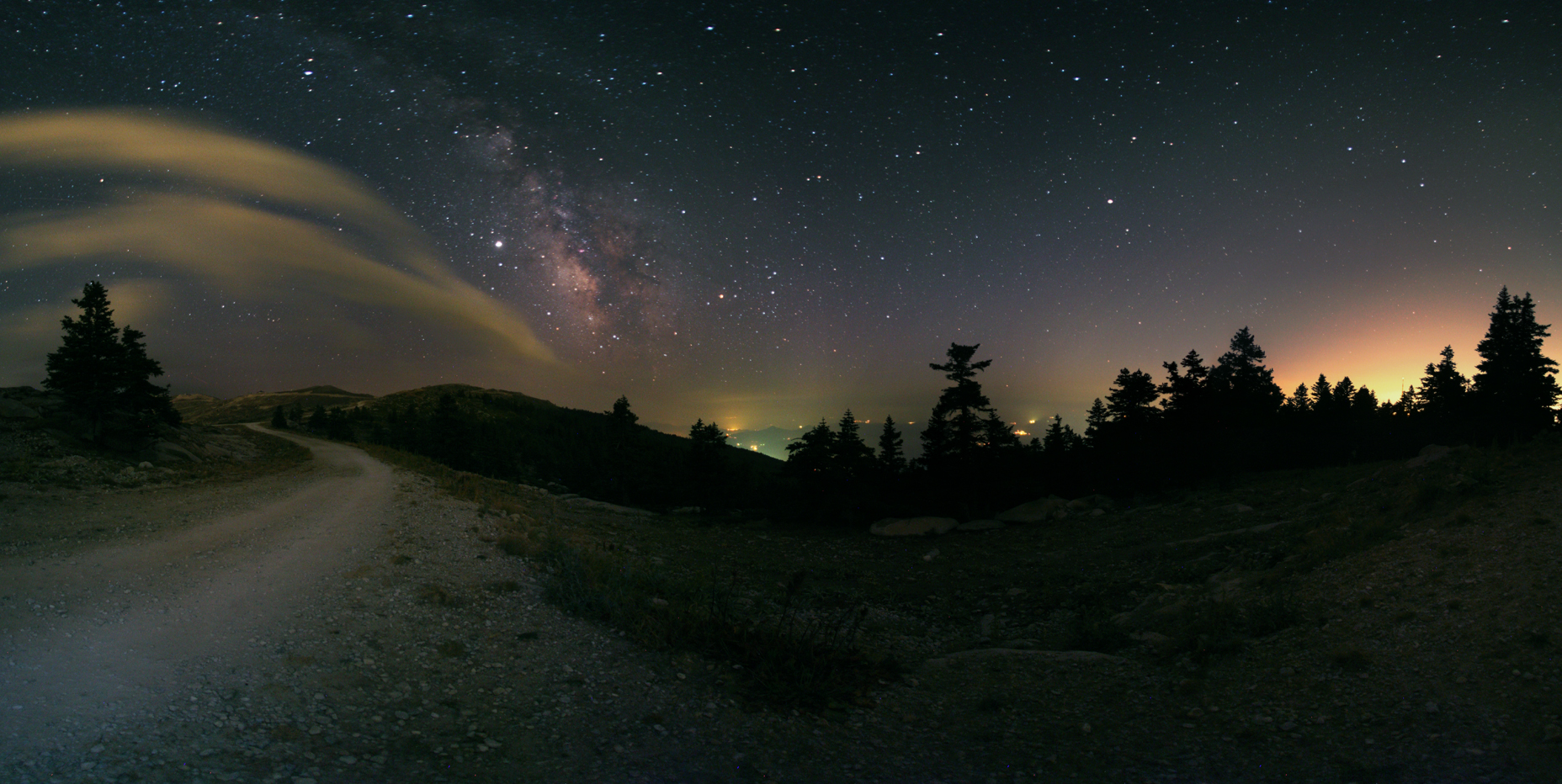
Landscape With Galaxy


Untitled photograph (reduced scale)
Astronomy Picture of the Day / NASA

I ran into this while rummaging around online. I don't know where it was taken, or when, but it's a remarkable combination of landscape and astrophotography.

Sunday, July 13, 2008

And Now, for Something Completely Different:
A Gallery of Sawn-In-Half Cameras

"A Gallery of Sawn-In-Half Cameras
Wired Blog Network (June 30, 2008)

"...The exhibit is full of retro gadgets, as you'll see below, but the most interesting to me were the bisected lenses and cameras, the insides of which show the precision of a CAD drawing. Read on to see sawn-off gadgets, the origin of digital cameras and a secret doorway just for horses...."

The title of this post is somewhat deceptive: one of the lens assemblies wasn't sawn in half. A quarter-section had been removed.

However, the many photographs and descriptive text may be a treat for those of us who will never see the Deutsches Technikmuseum Berlin.

Sunday, June 22, 2008

Very, Very Fast 'Shutter' Speed - Photos of a Nuclear Explosion

"1,000,000,000th Of A Second"
Yellow Swordfish (February 14, 2006)

"These photos have been around a long time but I have to thank my son for pointing them out to me. They were taken by the legendary Harold Edgerton in the Nevada desert at a range of 7 miles at 1/1,000,000,000th of a second, at night. These 3 pictures show the first 3 milliseconds of an atomic bomb detonation."

Three photos, more discussion, and a link to another site.

I've seen one of the photos before, but not the other two. Quite remarkable photography and science here.

Thursday, May 1, 2008

With an Explanation Like That, You Know it's Artistic

"Alphamega Series"
John Zoller

"These photographs capture the zenith moment in a physical process utilizing primordial destructive elements (fire, heat, light) and technology. This process mirrors the intention of the work: an exploration of the themes of birth and death, beginning and ending, transcendence, and the transference of energy."

Fifty photos.

What can I say? It's very artistic. And, easier to look at than the scrap lumber glued to canvas that passed for art a few decades ago.

Saturday, April 19, 2008

Black and White Photography: Color Isn't the Only Option

"Alley Photography
Mothic Future (January 25, 2008)

A half-dozen very presentable black and white photographs.

Lesson: color isn't necessarily better.

Tuesday, February 12, 2008

Eyeclops: Super Magnifying Camera

"Introducing the Eyeclops: Super Magnifying Camera"

It's a toy, but seems to be quite a versatile little optical unit. Signals from the eye go to a television set.

Many photos and description.
Unique, innovative candles

Visit us online:
Spiral Light CandleFind a Retailer
Spiral Light Candle online store

Pinterest: From the Man Behind the Lemming

Top 10 Most-Viewed Posts

Today's News! Some of it, anyway

Actually, some of yesterday's news may be here. Or maybe last week's.
The software and science stuff might still be interesting, though. Or not.
The Lemming thinks it's interesting: Your experience may vary.
("Following" list moved here, after Blogger changed formats)

Who Follows the Lemming?

WebSTAT

Family Blogs - Blog Catalog Blog Directory